






Understanding platelets: What happens when you have ITP?
Published 10 Sept 2026 • By Léonie Guerut
A blood test, a falling number, and a question that keeps coming up: “What does my platelet count actually mean?”
For people living with immune thrombocytopenia (ITP), platelet counts quickly become part of everyday life. Yet understanding exactly what platelets do in the body is not always straightforward.
What is their role? Why are they essential for stopping bleeding? And what happens when there are not enough of them?
In this article, we take a simple look at the role of platelets and explain what happens in the body when ITP causes the platelet count to fall.
What exactly are platelets?
Platelets, also known as thrombocytes, are small components of the blood.
Unlike red or white blood cells, they are not complete cells. They are formed from large cells in the bone marrow called megakaryocytes.
Their main role is in haemostasis, the set of mechanisms that allow the body to control or stop bleeding.
When we cut ourselves or a small blood vessel is damaged, the body needs to react quickly. Platelets are among the first players involved in this repair process.
How do platelets stop bleeding?
Imagine you get a small cut on your finger.
When a blood vessel is damaged, platelets are drawn to the affected area. There, they stick to the vessel wall, become activated, and cluster together.
In this way, they form an initial platelet “plug” that helps limit blood loss.
Other clotting mechanisms then step in to strengthen this process.
This system is well organised: the body is able to quickly detect a small injury and mobilise the necessary elements to repair it.
This is why platelets play such an essential role in the body, despite their tiny size.
What happens when the platelet count falls?
When the number of platelets in the blood falls below the normal range, this is called thrombocytopenia.
This decrease can have several causes. It may be linked to insufficient platelet production in the bone marrow, increased destruction of platelets, or excessive platelet use.
In immune thrombocytopenic purpura (ITP), now often called immune thrombocytopenia, the immune system attacks the platelets and speeds up their destruction.
The immune system, which normally protects the body against foreign substances, mistakenly identifies platelets as targets for attack.
As a result, the platelet count in the blood may fall.
Why is it called an “immune” condition?
The term “immune” refers to the way the immune system works.
In ITP, immune mechanisms lead to increased destruction of platelets. The body may also interfere with their production.
ITP is therefore considered an autoimmune disease: the immune system reacts against a part of the body itself.
This reaction helps explain why platelet counts can vary greatly from one person to another and may also change over time.
What symptoms can occur when the platelet count is low?
Thrombocytopenia sometimes causes no symptoms at all, especially when it is only moderate.
When the platelet count falls further, certain signs related to bleeding may appear.
Possible symptoms include:
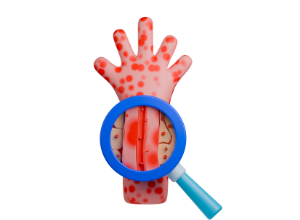
- petechiae, small red or purple spots on the skin;
- bruises or “blue marks” that appear more easily;
- nosebleeds;
- bleeding gums;
- heavier menstrual bleeding in some women;
- a tendency to bleed for longer after a minor injury.
However, the significance of symptoms does not depend on a number alone. Every situation is unique, and platelet count results should be interpreted by the medical team providing care.
Platelet count: why is this value monitored so closely?
For people with ITP, blood tests can become a regular part of everyday life.
The platelet count allows healthcare professionals to monitor the course of thrombocytopenia and adjust treatment if necessary.
However, it is important to remember that a blood test result alone does not tell the whole story of an illness.
Two people with a similar platelet count may be in very different situations. Symptoms, medical history, treatments, and the course of the condition are also taken into account.
This is why a blood count should not be interpreted alone or directly compared with that of another person living with ITP.
Can you live day to day with ITP?
Yes. ITP can vary greatly from one person to another. In some patients, it may be temporary. In others, it may last longer and become chronic.
Treatment depends in particular on the platelet count, symptoms, bleeding risk, how the condition develops, and each patient’s individual situation.
Medical follow-up therefore makes it possible to monitor the condition and adjust treatment if needed.
But living with ITP is not only about keeping an eye on a number.
The condition can also have psychological and social effects. Waiting for blood test results, worrying about bleeding, or feeling uncertain about certain activities can sometimes take up a large part of daily life.
This is also why talking with healthcare professionals and other people living with ITP can be so valuable.
Can you play sports with ITP?
Taking part in physical activity may depend on each person’s individual situation, particularly their platelet count and bleeding risk.
There is therefore no single answer that applies to all patients.
Certain activities may require greater precautions, especially those that involve a risk of knocks or injuries.
Before starting or changing a sporting activity, it is best to discuss it with your doctor or healthcare team, who can provide recommendations tailored to your situation.
Platelets: small cells, important role
Platelets are tiny, but they play a crucial role: they are involved in the first stage of stopping bleeding.
In ITP, their decrease is linked to an abnormal reaction of the immune system. Understanding this mechanism helps explain why blood tests and medical monitoring play an important role in managing the condition.
Behind the numbers on a blood test result, there is above all a person with their daily life, worries, and individual experience of the condition.
And this may be one of the most important points to remember: the platelet count is an important indicator, but it does not define the person living with ITP.
Key takeaways
- Platelets help stop bleeding.
- A decrease in platelet count is called thrombocytopenia.
- In ITP, the immune system destroys platelets in an abnormal way.
- ITP can cause petechiae, bruising, or different types of bleeding, although some people have few or no symptoms.
- Platelet count is an important part of follow-up, but it must be interpreted in a medical context.
- ITP can develop differently from one person to another.
If you found this article helpful, feel free to give it a “Like” and share your thoughts and questions with the community in the comments below!
Take care!
 Facebook
 Twitter
Quellen:
Assurance Maladie (ameli.fr) — Informations sur la thrombopénie et ses causes.
Orphanet — Purpura thrombopénique immunologique : informations sur cette maladie rare, ses caractéristiques et sa prise en charge.
Inserm — Informations sur les maladies auto-immunes et le fonctionnement du système immunitaire.
Haute Autorité de Santé (HAS) — Recommandations et informations relatives à la prise en charge du purpura thrombopénique immunologique.